Sunday, October 23, 2011

Steampunk Diving (Space) Helmet (pt.2)

It's been several months now since I started work on my Steampunk Diving Helmet  / Space Helmet, and a couple more since it was finished; so you might want to refresh yourself on this project by going back and reading the first post  for it here: Steampunk Diving (Space) Helmet (pt.1) WIP. When we left off, I was almost finished with the air tanks, and their construction had been a series of failures. We will finish those off later. First, let's get started on the helmet itself.

Fortunately, the helmet itself proved to be less troublesome than the tanks, though still quite a bit of trial and error and a whole pile of work. It all started with the search for the perfect sphere. I hunted for days looking for something with the right size and shape to be the basis for my helmet. In the end, I could not find exactly what I was looking for at a price I was willing to pay, so I settled on an inflatable beach ball. I was still experimenting with materials and techniques at this point, so I wasn't too worried that the ball was a little large and looked more like a pumpkin than a sphere. I figured I could always find something else and re-do it later. Of course that never happened.

I inflated the beach ball and coated it with petroleum jelly as a release agent. Then I went about covering it in a coat of papier-mâché. I used strips of paper torn from a phone book and cheap white glue. As you will recall, I am not adept at papier-mâché, so my results were not pretty.


Then I went about trying my newly found fiberglassing skills on the sphere. I used the ill fated "cheesecloth and resin" technique that I was pioneering on the tanks. It made for a leathery surface that had a lot more flex to it than I had expected.


When I was confident that the fiberglass was thick enough  to hold the sphere's shape, I removed the beach ball. Then I started figuring out where and how big I was going to cut my holes for the neck and three portholes. I used the rim of a bucket as a guide for the neck hole, and I used a 6" plastic plate as a template for the portholes.


 I cut out the holes with a pair of scissors (the fiberglass was pretty thin, so this was possible), but I had to be careful of cracking at the edges. I do not think I could have used scissors to cut the holes if I had not used the cheesecloth instead of actual fiber mat.

For the rims of the portholes, I searched the local dollar store for the right shape. I found what I was looking for in a child's plastic Easter bucket. I cut most of the bucket off, as I was only interested in about 2" at the base.  I used scissors for this too, as I could clean up the edge with a dremel after it was in place.


 I made adjustments to the portholes until I got the fit I wanted. Then I cut out the bottoms of the buckets with a dremel bit and glued the porthole rims in place with five minute epoxy. Now it was finally starting to take on a more recognizable shape.


 Next, I started work on the shoulder cowl. This I made out of cardboard. I taped two pieces of cardboard together and cut a large hole in the center for the neck. Then I bent the cardboard into a curve that would come over the shoulder, and down the back and chest. I left the back a little straighter and the chest a little more curved, as I am a big guy. I did a few trial fits on myself to see how close the front and back edges should be. The piece was very flexible at this point, and had to be held in place by blocks, but would eventually be ridged and hold its own shape after the fiberglass was applied.


 Before I could fiberglass, I had to marry the sphere to the shoulder cowl. That was a little tricky. As with most of the process in the build, I was flying by the seat of my pants. I had no idea how I was going to do any of this until I was elbow deep in doing it, so some things worked out better than others. The neck was a trouble spot.


 I created a collar out of cardboard to serve as a bridge between the sphere and the shoulder cowl. Getting it the proper size and placed perfectly was difficult.


 Once I was happy with the placement of the collar, I taped it in place with masking tape. Then I sealed the deal by laying on a coat of fiberglass all around the neck, thus permanently marrying the sphere with the cowl. This time (and from this point forward)  I used real fiberglass matting instead of cheesecloth. Then I went ahead and finished coating the entire cowl with fiberglass. This would give it the rigidity to hold its own shape without blocks. Once the fiberglass was dry, I could cut away the unnecessary parts of the cardboard collar. Actually, for the sake of getting my head into the thing, I would end up ripping or sanding out the entire cardboard collar, and even a little bit of the fiberglass covering it. I would patch these holes later with some more fiberglass and bondo. 


 After the cowl was fiberglassed, I went on to cover the entire sphere with two coats of fiberglass matting. I used the fiberglass to make a smoother, stronger transition between the sphere and the porthole rims, covering the rims from the outside with fiberglass mat.

At this point it was really starting to look like a diving helmet. I couldn't resist taking a picture of myself in it during a test fitting.


 With the helmet all glassed, I hung it over the back of a chair to get a look at how the air tanks would fit on the back. Those black hoses are something I found at a warehouse store for $0.45 each. I think they are supposed to be part of a funnel for automotive oil changes, or something. Not really sure. But for $0.45, hey, who cares!


I trimmed the corners off of the cowl to make for a smoother look. Then I gave the whole thing a coat of flat black spray paint  (I'm too cheap to buy actual primer) so I could get a better look at it as a solid unit. It would also give me a good base color that would help with the sanding, which comes right after covering the whole thing in bondo to smooth it out.


 I was unprepared for the nightmare that was the bondo and sanding ritual. I think it took about three days to get it somewhere close to smooth, and believe me, it is nowhere near as smooth as most of the prop artist's pieces I have seen on the web. I think the process when something like- primer, bondo, sanding, more bondo, more sanding, more bondo, more sanding, more primer, more sanding, spot glaze putty (which is a one part smoother version of bondo), more sanding, more spot glaze putty, more sanding, more primer, more sanding, more spot glaze putty, more sanding, more primer, give up.

I know it looks like a diving helmet already, but there is a lot more to come, so stay tuned.

See Also:
Steampunk Diving (Space) Helmet (pt.1) WIP
Steampunk Diving (Space) Helmet (pt.3)
Steampunk Diving (Space) Helmet (pt.4)
Steampunk Diving (Space) Helmet (pt.5)
Steampunk Diving (Space) Helmet Full Costume



Wednesday, October 12, 2011

Smudge Fan v2.0

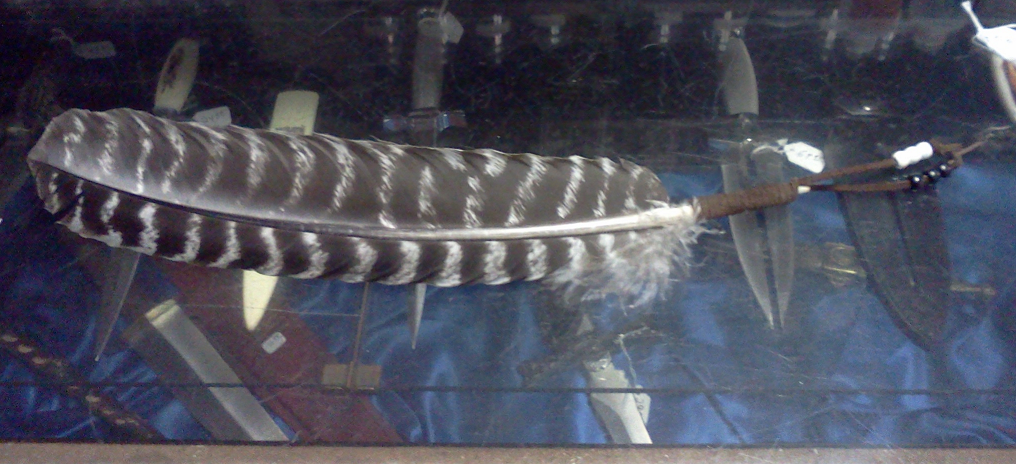
A while back I made a set of smudging fans with the hopes of making them cheaply enough that they would sell with each smudge stick. They were nice, but not nearly as simple to make as I had hoped they would be. Consequently, I didn't end up making any more of them.


This is my second attempt at a simple smudging fan. It is very simple and elegant. Just a nice large natural feather with some leather wrapping and a few accent beads. These should be very serviceable for simple smudging ceremonies and they are economical enough and simple enough to make that I can sell them as an add-on with each smudge stick sale. And actually, I like they way they look even better than the first ones I made.


UPDATE:  I have made a Smudging Fan v3.0, you can check it out HERE.


Sunday, October 9, 2011

Doctor Glamour - The Trailer

Early this year I did a series of posts about a very exciting project that I was commissioned to do for an independent film. I created two prop tomes for Andrew W. Jones's upcoming film short "Doctor Glamour". Well, it's been a long wait, but the film's trailer is finally out.

Doctor Glamour (Trailer) from Andrew W. Jones on Vimeo.

In this trailer, you can just catch a glimpse of my books. I'm very excited to see my work in a published format like this. I can't wait untill the final version is finally ready. It should only be another month or so.

See also:
Doctor Glamour - Necronomicon (pt. 1)
Doctor Glamour - Necronomicon (pt. 2)
Doctor Glamour - Necronomicon (pt. 3)
Doctor Glamour - De Vermis Mysteriis
Doctor Glamour - (fini)

Sunday, September 11, 2011

Bicorn Hat, Swords and Accessories

I did a lot of props and costume pieces for my larp at this year's Origins (Aethernauts: The Space Between - Steampunk Edition), one of which was the Steampunk Phonograph, which I posted about earlier, and another was the Space/Diving Helmet which was a major build that I will be posting more about soon. But I also did some smaller items. In hindsight, I wish I had spent a little less time on the props and costume pieces and a little more time on some other elements, but all in all the game ran pretty well. 

Many of the characters in this larp were Victorian era military officers, so I made some uniform pieces and accessories for them. First lets look at the simplest of the items. This is a plastic toy spyglass that I found at a discount store for about a buck. I made quick white canvas belts with brass buckles for the officers out of some old canvas webbing I had. I wanted accessories to match, so I made a spyglass holder out of a cardboard mailing tube wrapped in white butcher paper. The belt loop is chip board wrapped in white paper. It was attached to the tube with some glue and a heavy duty stapler.


Next up is this pistol holster. I had planned to make a steampunk rifle, but I didn't have the time. Instead, I decided to use my Nerf Maverick with the Steampunk paint job (the one pictured is not painted, it was just for test fitting). I wanted the body of the holster to be soft and flexible so that it wouldn't scratch the paint on the gun, so I used a sheet of white craft foam. This I glued into a cylinder, and added a belt loop made out of chipboard in the same manner as the spyglass holder. I made sure the cardboard for the belt loop ran the full length of the holster to give it more form and strength.


A very simple and inexpensive costume piece that easily differentiated the military personnel from the other characters, without having to create full uniforms, was to create rank insignia epaulets. These were made from just a piece of rectangular chipboard covered in black cloth. I then glued on strips of gold knotted trim and bits of ribbon from the fabric store. These would then be stuck onto the player's shoulders with a bit of double sided tape.


The epaulets I made for the retired Major-General were a little more complicated, but similar. I used a bit of gold satin fringe sandwiched between two pieces of chipboard (one slightly larger than the other). These ones were round on the ends to create the shoulder cup style of epaulet. The chipboard was sealed with mod podge and painted gold. The fringe was arranged around the cup and glued down to the larger piece. Then the smaller piece was used to cover this. The upper (smaller) piece also had some black ribbon added for additional decoration. None of these look very much like actual rank insignia from any country or period, but my project did not require period accuracy. They were only meant to convey the idea of a military uniform on a non-existent budget.


Some of the military officers was also given an officer's sword. I wanted these to be very cheap and simple. They turned out to be a little more complicated to make than I expected, but they looked pretty decent. After looking around the shop for a few minutes, I found a few pieces of wood trim that would work nicely. They weren't all exactly the same size, but oh well. I cut them all to the same length and trimmed down around the handle so that a piece of 3/4" pvc pipe would fit over the end. The pvc would serve as my handle. I wouldn't have to wrap or paint it, since I was going with a white trim theme. It would look like an ivory handle. I shaved down the tips into a rough point so that it seemed more sword-like, but I left the edges flat and made sure the points were quite dull so that no one would get hurt. The convention actually has rules against using these kinds of props in games, for safety reasons, but as long as no one gets hurt, they are seldom enforced.

I created a paper template for the hand guard and traced it out onto chipboard. This was then sealed with mod podge and spray painted gold and slid over the end of the handle. The blades were primed and painted with silver. Some glue and an upholstery nail at the pommel held the hand guard in place.


The scabbards were made from corrugated cardboard folded into a box that would fit around the blade. I left both ends open for simplicity. I wrapped the whole thing in masking tape and painted it gloss black. What really sold it as a scabbard was the piece of red ribbon trim that I glued down the side as an accent. I created belt hangers out of painted chipboard and a brass rivet. Chipboard wasn't really strong enough for this, and most of the belt hangers ended up broken by the end of the game, but they were only needed for the one event. The whole thing was topped off with some decorative cord tassels.


 The most difficult of the military costume pieces was the bicorn hat, that I had originally intended for the ship's Captain, but ended up giving to the retired Major-General. I had to do a little digging on the internet for ideas on how to make the hat. Most helpful was posting on the Replica Prop Forum where I found out the proper name for such a thing, which then led me in the right direction to finding reference images and such.

Again, this needed to be done on the super-cheap, so back to my good old friend, chipboard. At $1.75 a sheet, it is hard to beat. I sketched out a rough circle on the chipboard, and at the center of it I cut out an oval with measurements that roughly matched the dimensions of my head. I made it a little tight on purpose, figuring it is easy to remove material, not so easy to put it back.


Next came the shaping of the chipboard. This was harder than I thought it would be. It took several days of pushing and prodding and pinning with clips and clothes pins to get it to where I wanted it. The best work was done after I realized that the chipboard would form well after it was wetted down with a misting of water. That made it easier to bend without creasing, and it allowed the board to mold to the desired shape and stay there after it dried.


After shaping, I needed to cover the chipboard with something. I was hoping to find some sort of spray on flocking material to give it a cloth like texture, but I was unable to find anything like that locally. I briefly considered just spray painting it, but ultimately decided to just cover the thing with cloth. Fortunately, I had stocked up on cheap black cotton cloth back when Wal-Mart had a fabric department. I applied the cloth with spray glue and was careful to avoid wrinkles.


After realizing that you could see the glare form my bald head through the hole in the front during a test fitting, I added a swath of black cloth loosely across the head opening, to prevent this. 


As the final detail, I added a trim of fake white fur all around the edges. I considered some sort of ribbon or decoration on the side too, but decided not to. The two sides of the hat was then closed up with a few pieces of double sided foam tape.


Here is a pic from the larp so you can see some of the props in action. More pics from the larp will be posted on RogueCthulhu.com (eventually).